Identifying a gun
An inherited shotgun: identify it, date it, and know whether it can still be fired
What a gunsmith looks at before saying anything, in order, and what he will never tell you from a photograph
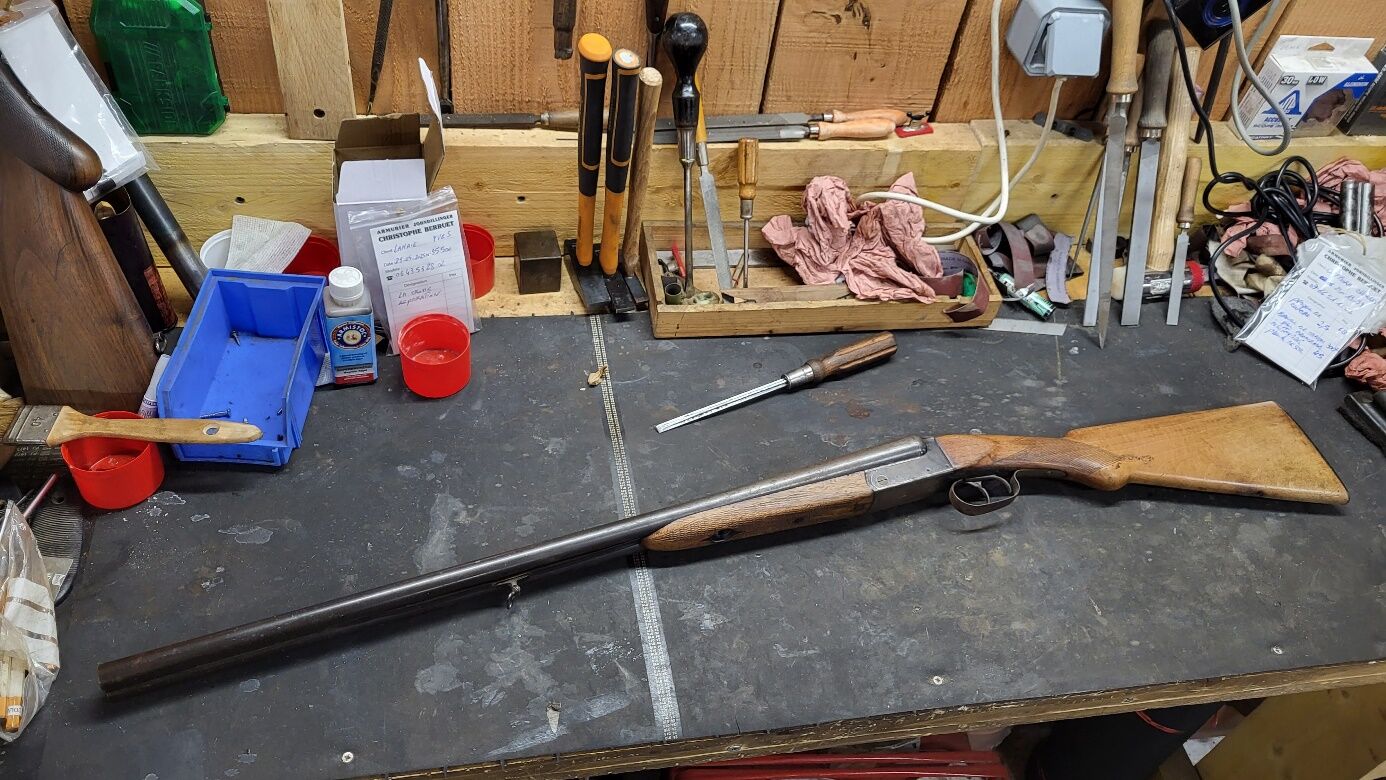
A shotgun that comes out of a cupboard after a death in the family always raises the same questions: what is it, how old is it, can it still be fired, and what is it worth. The first three can largely be read on the gun itself, under the barrels and on the action, provided you know where to look and take nothing apart beyond the barrels. The fourth I do not answer, and I explain why.
01Where the clues are
Almost everything a gun says about itself is stamped in two places you cannot see when it is closed: the barrel flats, that is the underside of the barrels at the chambers, and the action table, the surface the barrels rest on. To see them, remove the fore-end, drop the barrels and lift them off the action. That is the only disassembly needed, and it is the one every break-action gun is designed for.
You will find three families of marks there. The proof marks, struck by an official proof house, which say in which country the gun was proved, with which powder, at which gauge and sometimes in which year. The maker's or retailer's marks, often on the barrels, the action or the rib. And a serial number, when there is one. The words I use here, action, fore-end, flats, table, are in my French-English glossary of gun terms if one of them is missing.
02Where it comes from, and when
Proof marks are the most reliable evidence, because they were struck by an official body and they are documented. The two proof houses I document, Liège and Saint-Étienne, proved the great majority of the old game guns found in France.
A Belgian gun carries the « ELG » oval. Crowned, it was proved after July 1893; uncrowned, before. A lion above the letters « PV » marks the smokeless-powder proof, introduced in 1898. And above all, from 1922, a small letter struck near the proof marks gives the year of proof: that is the Liège date-letter tool in my directory, one letter, one year. That year is the year of proof, not necessarily the year of manufacture or of sale.
A Saint-Étienne gun carries the marks of the French proof house: a crowned « PT » for the ordinary smokeless proof, from 1900, a crowned « PS » or « PM » for the first smokeless powders, which places the gun before the mid-1920s, a crowned « F » for black powder. Saint-Étienne never struck a date letter: you date by the combination of marks and by the clues I list in the directory.
Other proof houses exist, Birmingham and London, Eibar, Gardone, Suhl, each with its own marks, which my directory does not yet cover. And an American gun generally carries no national proof mark at all, the United States having no official proof house: the absence of a mark is then a clue, not an anomaly.
A Liège gun is read mark by mark, oval, lion, lozenge and date letter, in the article on ELG proof marks.
03Gauge and chamber length
This is the question that decides the cartridge, and the one that injures people when it is neglected. A 12 bore is not a 12 bore: the chamber is 65 mm, 70 mm or 76 mm long, and the cartridge must be the length of the chamber or shorter, never longer. A 70 mm cartridge fired in a 65 mm chamber opens in the forcing cone instead of in the chamber, and the pressure rises beyond what the gun was proved for.
The official CIP tables, the body that sets proof standards in Europe, give the 12/65 a case of 65 mm at most and a chamber of 2 1/2 inches; the 12/70 a case of 69.8 mm and a chamber of 2 3/4 inches; both are limited to the same maximum average pressure of 740 bar, while the 12/76 goes up to 1,050 bar. Old 16 bores are very often chambered for 65 mm, that is 2 1/2 inches.
On a Liège gun, the chamber length is struck together with the gauge in a cartouche, « 12-70 » or « 16-65 », from 1924; before that, the gauge alone appeared in a lozenge, with no length. On many old guns the chamber may have been lengthened later by a gunsmith, without a new mark. That is why a gunsmith does not trust the stamping: he measures the chamber with a gauge. Do not order cartridges before that measurement.
The details, markings, gauge and the 16 bore, are in the article on 12-65 versus 12-70 chambers.
04The barrels: steel or damascus
A damascus, or « twist », barrel is made of ribbons of steel and iron welded in a spiral around a mandrel; you recognise it by the pattern that shows through the finish, twists or chevrons, sometimes only in raking light. These barrels were made until the early twentieth century and most of them were proved for black powder, which the marks say: a crowned « F » at Saint-Étienne, an « ELG » oval without the « PV » lion at Liège. A damascus barrel carrying a smokeless proof does exist, but it has to be read on the flats, not assumed.
The position of the British proof houses, who are the authority on this subject, is clear: steel shot ammunition, even standard steel, is not to be used in guns with damascus or twist barrels, and for guns bearing marks earlier than 1954 they recommend re-proof rather than an opinion.
What really decides is neither the pattern nor the age, it is the wall thickness of the barrels, measured at several points, and the absence of dents, deep pitting and enlarged bores. The British Rules of Proof of 2006 put numbers on it: a shotgun barrel whose bore has been enlarged by more than 0.2 mm beyond the marked size, by wear or by work, is deemed out of proof, as is any gun in which a highly stressed action or breech part has been altered or replaced; and a barrel submitted for re-proof must be free of rust, pitting, dents and bulges, with the action tight on the breech face. Those measurements are taken at the bench, with instruments, and no photograph replaces them. A gun can also be submitted to a proof house again: that is what was done for the Winchester of my diploma, proved at the French national proof house in Saint-Étienne at 2,750 bar, with a certificate.
I have written a separate article on damascus barrels: what the proof marks say, what the proof houses say, and what only wall measurement settles.
05General condition, what you can see for yourself
Four observations need no tools, chambers empty.
Lock-up. Gun closed, one hand on the stock, the other on the barrels, feel for play between the barrels and the action. A gun that rattles or moves is no longer tight: the barrels are said to be off the face.
The barrels. Against the light, look at the outside for dents and scratches, then inside the bore for pitting, those small craters of old rust. A bright, smooth bore is a good sign; a grey, grainy bore calls for a measurement.
The wood. The weak point is the wrist of the stock, just behind the action, where the wood is thinnest: look for a crack, even a fine one, and for play between wood and metal. A cracked stock can be repaired, but not by pouring glue into it.
The mechanism. Cock and drop the hammers dry, chambers empty and barrels towards the ground: the hammers must hold at full cock without slipping at the slightest knock, and the triggers must break cleanly.
These observations tell you whether the gun deserves a visit; they do not replace the inspection. At the bench, the gunsmith measures barrel wall thickness and chamber length, checks the lock-up and the bolting, and looks inside the action. Only then can he say: yes, with this cartridge; or no, and here is why.
To read the inside of a barrel once it is clean, see “is this normal?”; for rust and bluing, what you can do yourself; for a cracked wrist, repair or replace.
06And what is it worth?
I will not say, neither here nor by message, and it is not politeness. This site is not a shop: I sell nothing, I quote nothing and I value nothing. A value depends on the maker, the real condition, what is original and what has been redone, the proof, and a market that moves; it is given with the gun in hand, by someone whose trade it is, a professional dealer or a specialist auctioneer. What I can do here is help you know what you are holding, so that the conversation with them starts from the facts.
If you are buying rather than inheriting, the list of what I check before buying also serves to judge what you are holding.
07And the law?
In France, an inherited or found firearm must be declared, and the procedure goes through the Système d'information sur les armes, the official portal of the Interior Ministry. The options are, depending on the category of the gun and your situation, to keep it, to sell it through a dealer, or to hand it over to the State. I do not detail those rules: they depend on the category, on your case, and they change. Prefecture pages explain them, and a gunsmith will point you in the right direction. Outside France, your own country's rules apply.
The categories themselves, C and D, and what each requires, are in which gun without a licence.
Swipe to explore the diagram
Common questions
- The gun carries no proof mark at all. Is that normal?
- It happens, and it says something. An American gun generally has none, the United States having no proof house. A European gun with no mark at all on the flats is rarer, and deserves an inspection before any shot all the more.
- My gun is marked 12-65. Can I fire 70 mm cartridges?
- No. The cartridge must be the length of the chamber or shorter. And since a chamber may have been lengthened without a new mark, have it measured before buying cartridges.
- Can damascus barrels be fired?
- That is not decided by the barrel pattern or its age, but by wall thickness, the state of the bore and what the proof marks say, at the bench. Never with steel shot. Re-proof at a proof house is possible.
- Should I clean it before showing it to a gunsmith?
- A dry cloth on the outside, nothing more. Dust does not hinder the inspection; polishing or sanding does, because it erases what needed to be read.
Sources
- CIP, Tables de dimensions des cartouches et des chambres, tableau VII, cartouches à grenaille (12/65, 12/70, 12/76, 16/65)
- CIP, Anciens poinçons d'épreuve : France (document officiel, 2001)
- Banc National d'Épreuve de Saint-Étienne, fiche « Épreuve des armes »
- British Proof Authority et GWCT, table d'équivalence des poinçons et usage des munitions à grenaille d'acier, dont l'exclusion des canons damas et la recommandation de réépreuve avant 1954
- Gunmakers' Company et Birmingham Proof House, Rules, Regulations and Scales applicable to the Proof of Small Arms, 2006 (règles 5, 7 et 9 : canon hors d'épreuve, réépreuve, état exigé)
- Planche des poinçons du Banc d'épreuves de Liège, avec la table des lettres annales (PDF hébergé par hunting.be)
- Préfecture de la Seine-Maritime, « Arme héritée ou trouvée », et le portail SIA du ministère de l'Intérieur
- NRA Museum, Proof Marks (absence de banc d'épreuve national aux États-Unis)
- National Park Service, Conserve O Gram 10/1, Caring for Historic Longarms (1999) : toute arme ancienne se manipule comme chargée et ne se tire jamais avant contrôle