Finishing recipes travel from forum to forum, and they contradict each other: 50/50 or 80/20, five coats or twenty, two hours or three days. This reference puts the ranges side by side, finish by finish, with a source for every figure. Where the schools disagree, the page says so instead of deciding for them.
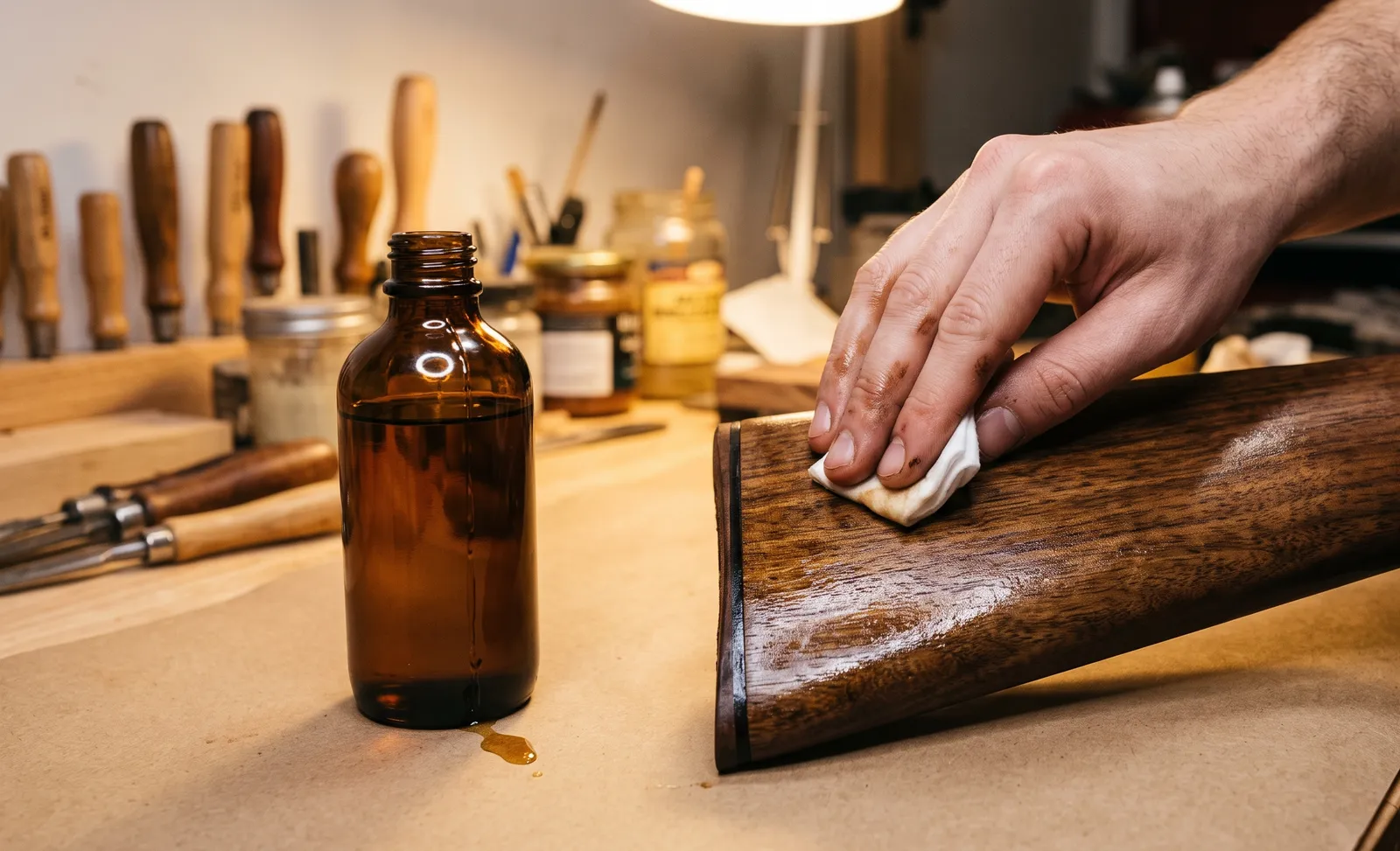
A traditional linseed oil finish on a walnut gun stock is built up in thin coats: the first ones thinned with turpentine (often 50/50), then progressively less diluted oil, wiping off the excess after 10 to 15 minutes. Expect 5 to 10 coats, 24 to 48 hours apart.
Illustrative photo
Safety, before anything else
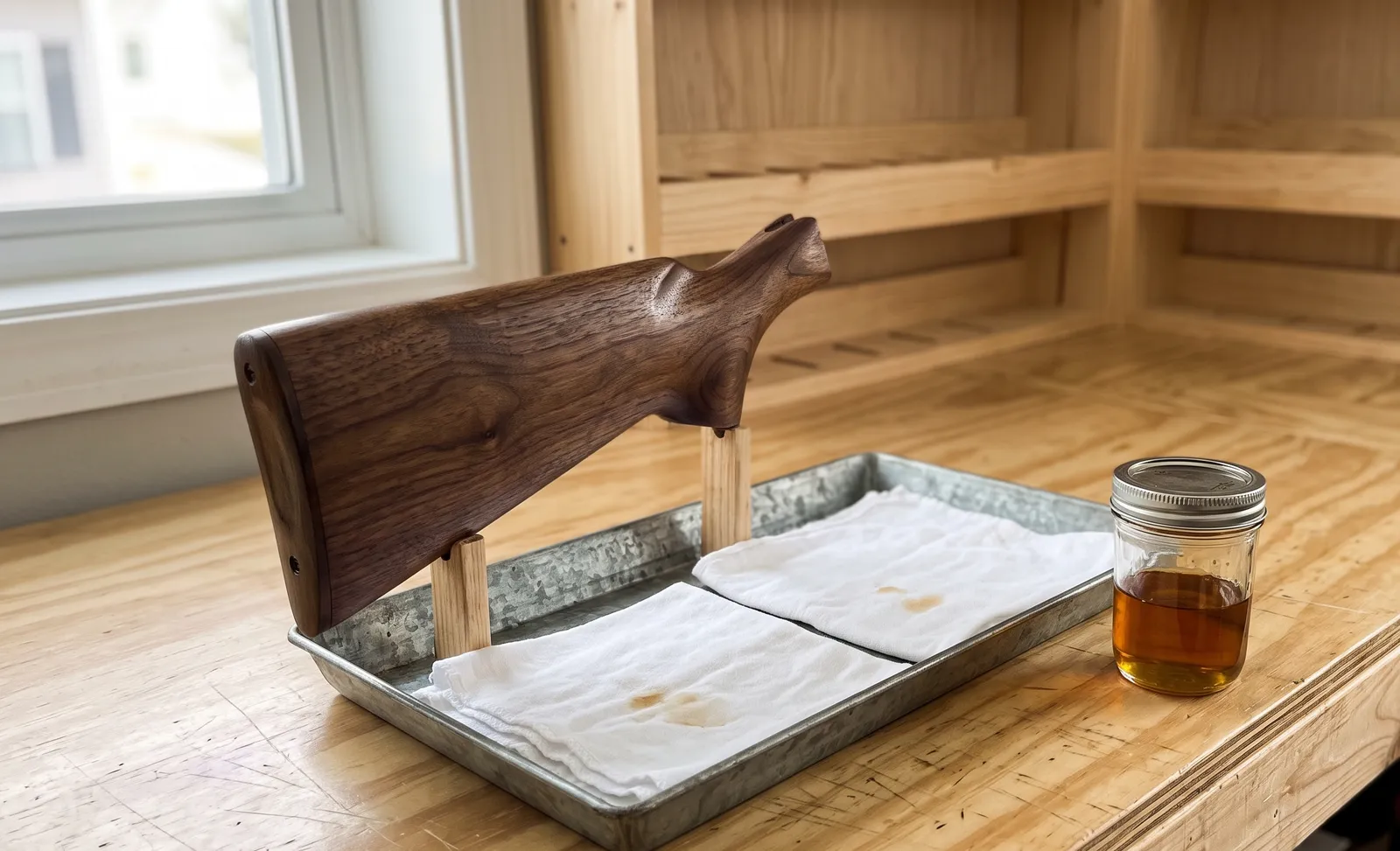
A rag soaked in linseed oil can catch fire on its own: the oil's oxidation gives off heat, and a balled-up rag traps it until the cloth self-ignites. Never throw an oily rag in a ball or into a closed bin: lay it out flat to dry, or submerge it in water. That is the fire services' instruction (source at the bottom of the page).
Illustrative photo: rags dry flat, never balled up
Linseed oil, Tru-Oil, tung oil or wax: what should you compare?
These pointers come from manufacturer instructions, not a comparative workshop test. Wax complements an oil finish; it does not replace the three oils in this table.
On small screens, scroll the table horizontally.
Linseed oil, Tru-Oil, tung oil or wax: what should you compare?
Sheen and surface protection, added over the finish.
Over Tru-Oil, Birchwood Casey specifies at least 7 days after the final coat.
The cited Gun Stock Wax contains carnauba, beeswax and silicone: wax formulations differ.
Time between coats is not the same as full curing time. The figures in the table apply to the named product under the conditions in its instructions. Check the formulation, wood condition and manufacturer guidance before transferring a recipe. Sources checked on 12 October 2026.
01 · The reference sheets
Four finishes, four temperaments
The French tradition
Linseed oil: the French rubbed finish
Thinning
First coats thinned with turpentine, most often 50/50; some workshops step up through 80/20 then 95/5 before neat oil.
Number of coats
5 to 10 thin coats in common practice; saturation purists go to 15 or 20. You stop when the wood no longer drinks.
Time between coats
24 to 48 h as a rule: a few hours with driers, several days for raw oil. The wood must be dry to the touch before the next coat.
Raw or boiled
Raw oil dries in 3 days or more per coat; so-called boiled oil (metallic driers added, it is not actually boiled) in 12 to 24 h. Driers are debated: small doses for some, avoided by others.
Between coats
Light denibbing: 000 or 0000 steel wool, or 800-grit paper.
The move that saves it all
Wipe off the excess 10 to 15 minutes after each application, then a final buff with a wool cloth.
The workshop test: a cloth with a drop of turpentine, rubbed on the finished stock, must not pick up colour.
The American standard
Tru-Oil (Birchwood Casey)
Number of coats
4 to 6 thin coats applied with the finger: the manufacturer's own figures, which vary between its documents.
Time between coats
12 to 24 h between coats; 7 full days of drying before wax or a satin rub-down.
Between coats
400-grit paper or fine steel wool if there are runs, then a tack cloth.
What it is
Petroleum solvent, modified oils and linseed oil (manufacturer's safety data sheet): faster-drying and glossier than a plain oil.
The last coat goes on thin and even: it dries glossy. For satin, rub down after a week.
The non-yellowing alternative
Tung oil (China wood oil)
Thinning
Neat, or thinned 50/50 with solvent for the first coats and very hard woods.
Application
Let it penetrate 15 to 40 minutes, then wipe all the excess with a dry cloth.
Time between coats
24 to 48 h; repeat until the wood is saturated.
Full cure
7 to 14 days to dry hard, about 30 days of cure before hard use.
Versus linseed
Does not yellow or go rancid, better water resistance; the trade-off is the slow cure.
The finishing touch
Wax (beeswax and carnauba)
Role
Sheen and surface protection over an oil finish; carnauba hardens the blend, beeswax alone is too soft.
When
Only on a fully dry oil finish: at least 7 days after Tru-Oil per the manufacturer, 2 to 3 weeks for the cautious.
Application
A thin, even coat, buffed with a cloth until the haze is gone.
Upkeep
Renew periodically: wax wears, it does not flake.
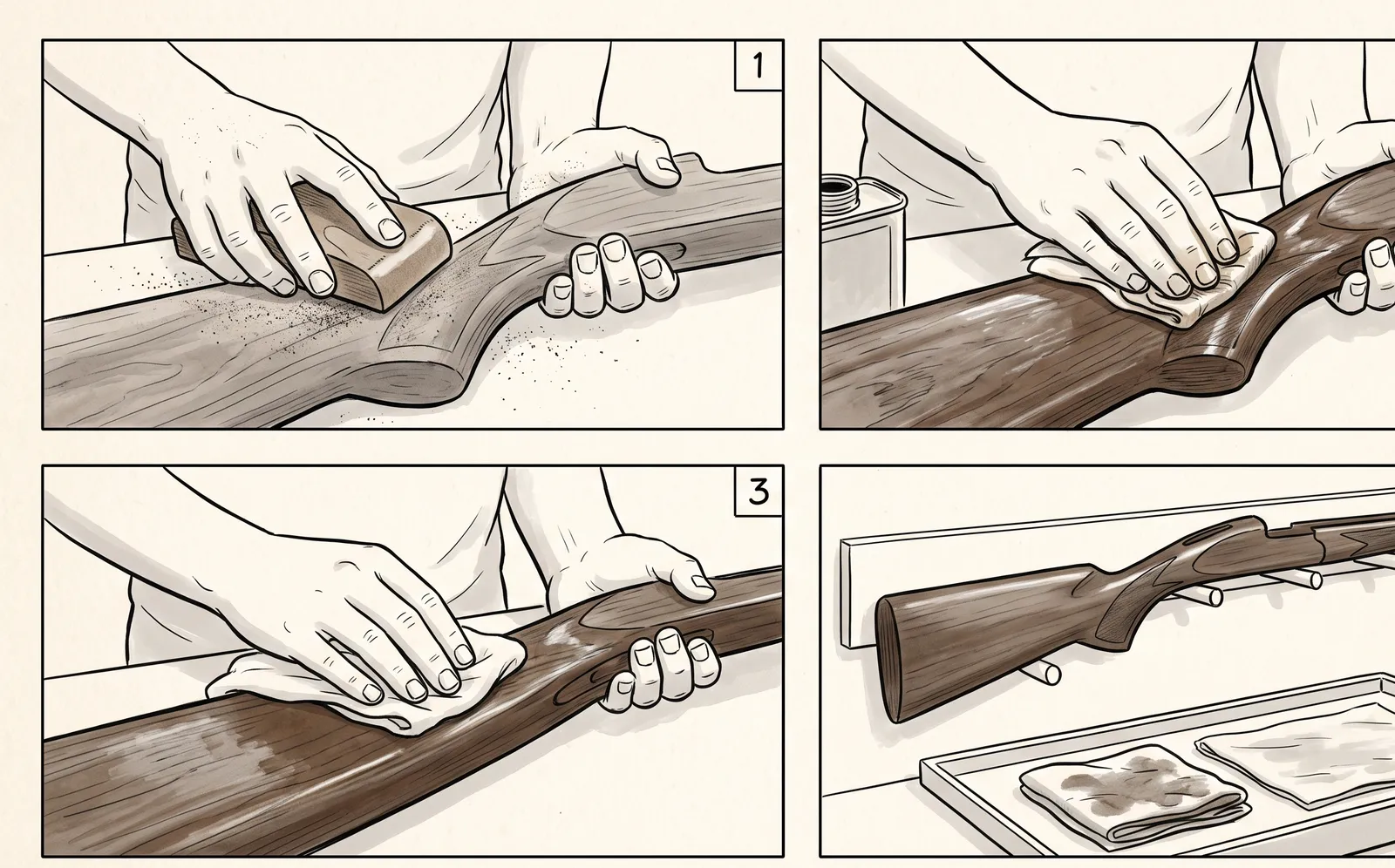
Illustration: the craft in four steps
02 · Troubleshooting
When the stock says no
Symptom
Likely cause
The fix
The finish stays sticky or tacky
Coats too thick, or the excess was not wiped off.
Thin coats; wipe the excess 10 to 15 minutes after applying; allow longer hardening between coats.
Stock saturated with old oil, very dark
Decades of oiling: oxidised oil has darkened the wood in depth.
De-oil with washing soda and very hot water, brushed on (gloves and goggles), rinse, then dry slowly, away from any heat source.
Wood pale or dull after de-oiling
The alkaline treatment lightens the surface.
The colour returns with the first coats of oil; oxalic acid evens out stains; fine-sand (400 grit) before re-oiling.
Black stains after cleaning with alcohol
Methylated spirit used on wood that was still damp.
Use 95° industrial alcohol, never methylated spirit.
Unsure whether a rubbed finish is sound
Poorly hardened film or excess oil.
Rub with a cloth carrying a drop of turpentine: if it picks up colour, the finish needs redoing.
One rule runs through every case: almost every failure comes from excess. Too much oil, too fast, too thick. A rubbed oil finish is a craft of patience, not of product.
03 · The English tradition
The London finish and its slacum
In the great English houses, the finish goes by the name of a workshop secret: slacum, a house blend of drying oil, wax, turpentine and resins whose recipe every maker guards. Purdey's is not Holland & Holland's. One published recipe gives the spirit of it: boiled linseed oil, turpentine, carnauba wax and Venice turpentine, simmered together.
Before the slacum sometimes comes red oil, linseed in which alkanet root has steeped for months, warming the colour of the walnut and bringing up the figure. Then thin coats, rubbed in hard with the bare hand, days or weeks apart. The finish is in the wood, not on it: that is the whole difference from a varnish, and what makes it endlessly repairable.
It is the same logic as stocking itself: time is part of the toolkit. The dimensions that come before the finish are in the length of pull tool, the vocabulary (poncé-huilé, French polish, chequering) in the French gun terms glossary, and the result in the flesh on the stock of my Winchester M1885.
Sources
Figures cross-checked between official manufacturer instructions, detailed protocols from specialist forums and woodworking references, consulted on 18 July 2026. Where sources diverge, the page gives the range. Recipes are bearings, not gospel: the test piece of walnut has the final word.