Bespoke creation · BMA graduation project · September 2025 to May 2026
Winchester M1885 “Freddie Mercury”
Nine months to turn an Uberti base into a one-off piece: woodwork, sights, furniture and every finish, from my drawing board to the French National Proof House
My graduation project for the French Craft Diploma in Gunsmithing: a falling-block rifle in .45-70 Government, in tribute to Freddie Mercury. On an Uberti model 1885 mechanical base (barrel and receiver), I made everything else: SolidWorks modelling, walnut swan-neck stock, beech forend, Martini-Henry type sights, barrel bands, fore-end cap, finger lever and every finish. I also designed and machined the prototype of an in-stock cartridge storage system, which stayed on the bench: it is not fitted to the rifle. Official verdict of the French National Proof House: compliant.
- 740 mm
- octagonal barrel
- 1,174 mm
- overall length
- .45-70
- Government, the calibre
- 2,750 bar
- proof pressure at the French Proof House
- 1,510 €
- total budget, held
- 9 months
- in the workshop, September 2025 to May 2026
01The concept: one gun, one legend
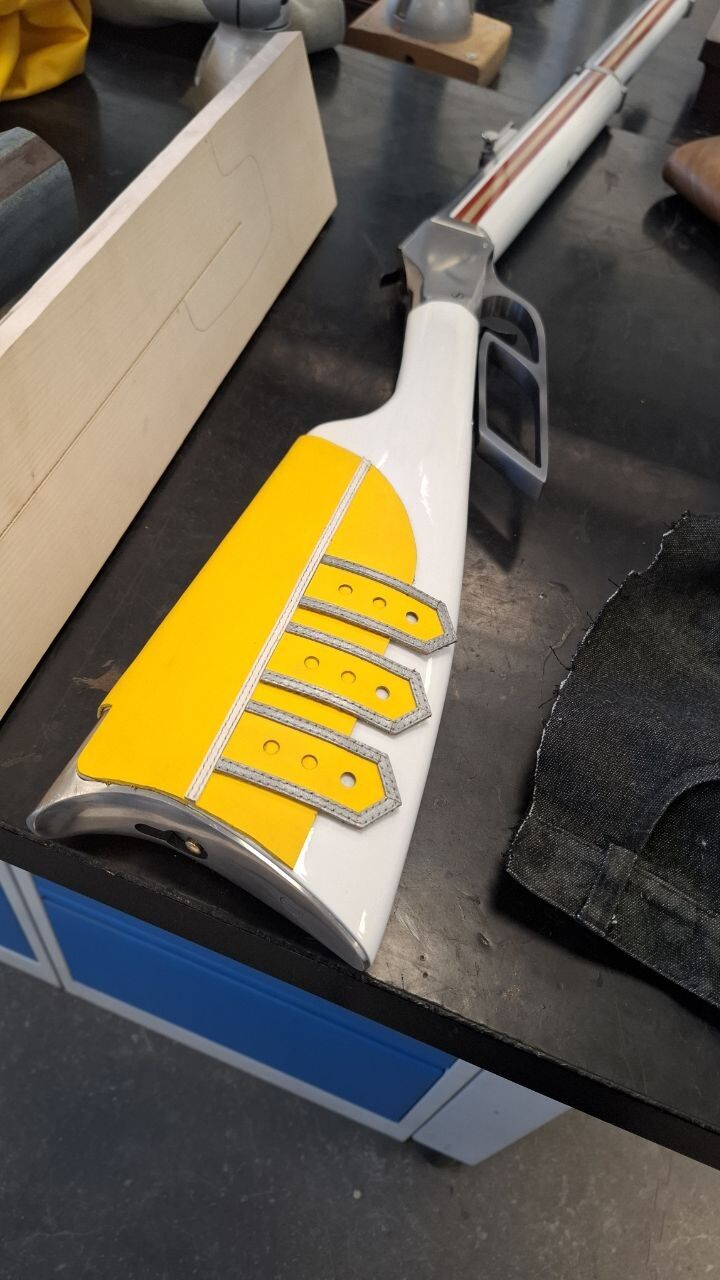
For my graduation project I wanted an ornamental piece that tells a story. I chose Freddie Mercury, and built the rifle's entire visual vocabulary from his stage costumes: the Houston 1977 chequer becomes the forend pattern, the white leotard becomes the stock lacquer, the yellow Wembley 1986 jacket becomes the leather set into the wood. The project's motto, “I Won't Be a Rockstar, I Will Be a Legend”, drove nine months of work.
02Design: SolidWorks before steel
Every part existed first in three dimensions in SolidWorks: the full assembly, the finger lever, the rear sight, the front sight and its drawing, the forend, and the five parts of my cartridge storage prototype. Modelling first means making your mistakes on screen rather than in the material: dimensions, clearances and kinematics were validated before the first chip was cut.
03The Uberti base, and everything else
I say it plainly, because that is how trust is earned: the barrel, the receiver with its falling-block mechanism and the buttplate come from Uberti (€720 of the budget). Everything else came from my hands: the woodwork, the sights, the barrel bands, the fore-end cap, the finger lever, and every finish. The barrel itself was reworked: turning, breech and muzzle threading, rear sight fitted and soldered.
04The barrel: octagonal, .45-70, 740 mm
Chucked with a dial indicator to guarantee concentricity, outside turning, breech-side and muzzle threading. The finish is a progressive polish, with the regulation markings on the bottom flat.
05The receiver: refiled and polished
The receiver houses the falling-block mechanism. I refiled it lightly for a sportier line, then polished it. The artistic engravings planned in the project (portrait, piano, motto) went no further than a test plate: the gun carries no engraving, and I would rather write that here than let anyone believe otherwise.
06The test plate: the engraving that was not done
Before deciding, I made a test plate. It was a proposal for dressing the receiver: trial bands at the top, a piano keyboard, the motto “I Won't Be a Rockstar, I Will Be a Legend” lettered out, and Freddie Mercury at the end of the Wembley concert in 1986, crown and sceptre. That is what a plate is for: you try it on a flat piece of metal, not on the part.
The decision was not to engrave the receiver. So the plate stays what it is, a trial, and the rifle carries no engraving. I am showing it anyway. A trial that does not go onto the gun is still a trial that was done.
07The finger lever
Redesigned then made: milled, welds dressed with riffler files, levelled to follow the receiver line, edges rounded. The trigger guard carries colours obtained by heat tempering, a controlled heat oxidation, a nod to stage colours.
08The woodwork: walnut, beech, red chalk
The swan-neck stock is shaped from a solid walnut blank: the receiver bedded with red chalk (coat the metal, find the contact points, touch up, again and again), roughed out with a drawknife, then the drop, cheekpiece and comb shaped, the buttplate shortened and fitted. The beech forend has its centre groove milled, then is sculpted with rasp and drawknife. The steel band, cap and nose cap are made and fitted to the flats of the octagonal barrel, down to the screws, turned on the lathe.
09The sights, Martini-Henry type
I replaced the original sights with a leaf rear sight and front sight inspired by the Martini-Henry, for a more military silhouette. SolidWorks design, milling (45° flats, grooves, dovetail), making the spring, leaf and slider, then fitting to the barrel.
10The prototype: an in-stock cartridge storage system
A single-shot rifle means constant reloading. I designed a cartridge storage system meant to be housed in the stock: five parts (lever, lever pin, rocker, rocker pin, base plate), modelled in SolidWorks and then machined in the workshop. The principle: cartridges are inserted one by one by pressing the lever; on demand, the rocker releases the top cartridge while blocking the next, and a spring returns everything to position. The system is independent of the firing mechanism: the kinematics of the rifle are unchanged, and the French C1-c classification would be retained.
I say this as plainly as the rest: the parts were made and assembled on the bench, but they were never fitted to the rifle. It remains a prototype. Fitting it into the stock and testing it are still to be done.
11The finishes: white, yellow, chequer
The stock is lacquered white and set with a fitted yellow leather overlay. The forend receives its black-and-white chequer by hydro-dipping, a water transfer entrusted to a specialist subcontractor (€300 of the budget): knowing when to delegate the right operation is part of the trade too. Nose cap and furniture are mirror polished.
12Proof firing: 18 May 2026
A firearm only legally exists after proof. On 18 May 2026 the rifle went through the French National Proof House in Saint-Étienne: proof firing at 2,750 bar to CIP standard, inspection, proof mark. Verdict: compliant.
- Certificate
- no. 3572411
- Proof
- 2,750 bar (CIP standard)
- Verdict
- Compliant
- Category
- C1-c (France)
- Date
- 18 May 2026
13The budget: €1,510, held
- Receiver and barrel (Uberti M1885)
- €720
- Tooling and leather goods
- €330
- Hydro-dipping (subcontracted)
- €300
- Wood (stock and forend)
- €100
- Yellow leather
- €30
- Proof house
- €30
- Total
- €1,510
14Looking back
Nine months in the workshop, September 2025 to May 2026: metal from September to January, wood in March and April, finishing and assembly in April and May, proof on 18 May. This rifle demanded every skill of the trade: machining, fitting, woodwork, mechanics, finishing, and the discipline of holding a schedule and a budget. My thanks to Pierre Le Bihan and Christophe Berruet (John Dillinger gun shop, Beaulieu-lès-Loches), to the Jacques Denys gun shop (Saint-Hilaire-du-Harcouët), and to my teachers at the Benoît Fourneyron school.
The show must go on.
Freddie Mercury
Gallery