Tools · 01
Length of pull, measured properly
Gun fitting is at the heart of my trade as a stockmaker: shaping the wood of a gun to the person who mounts it. It all starts with four measurements. This page explains them, gives the usual ranges with their sources, and offers a starting-point estimator. No online tool replaces a real gun mount: this one is here so you understand what you are measuring, and start from a sensible number instead of a habit.
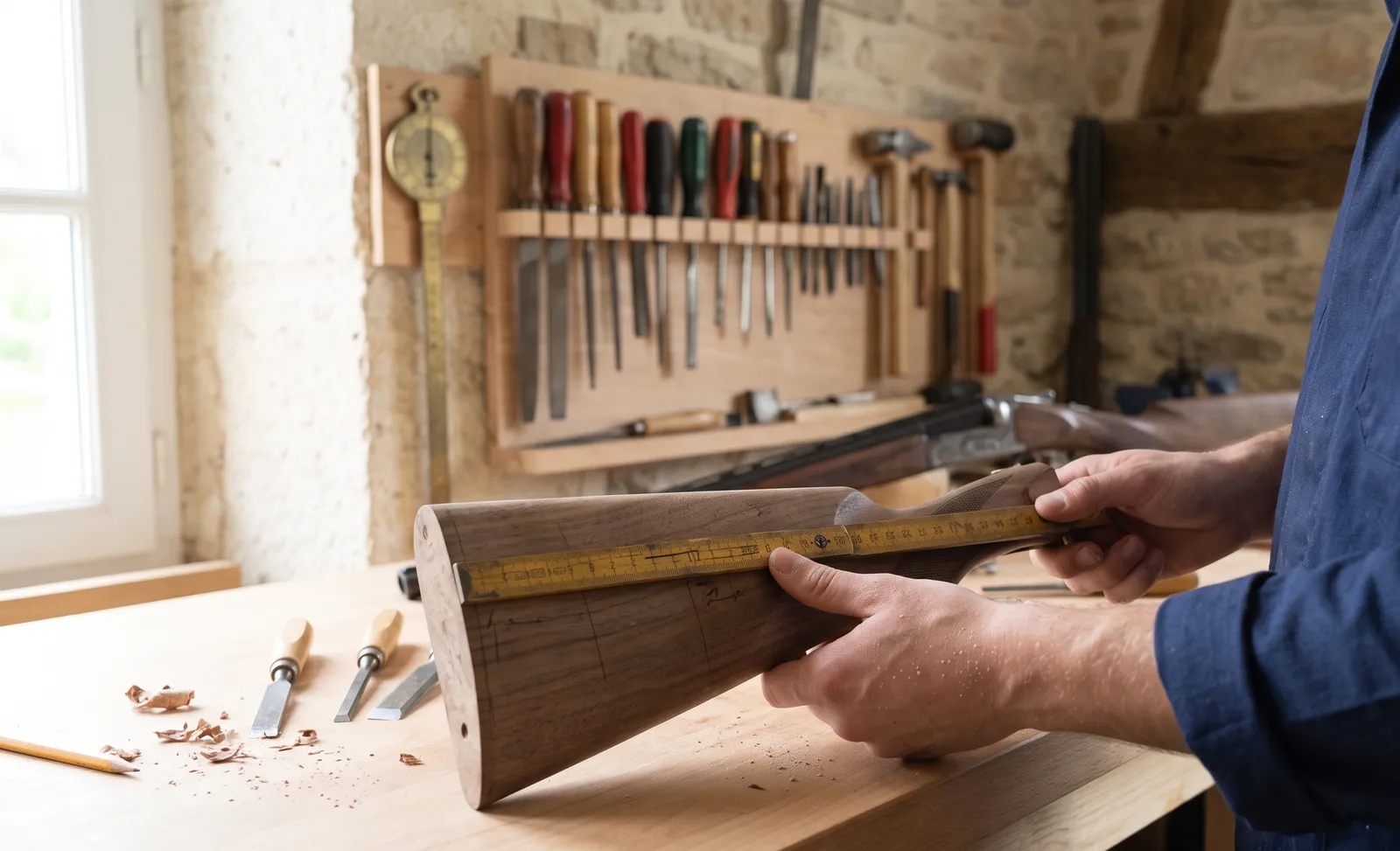
Length of pull is measured in a straight line from the middle of the trigger (the front trigger on a double-trigger gun) to the centre of the buttplate. On a factory shotgun it most often falls around 14 ¼ in (360 to 365 mm); standard factory stocks run from 13 ½ to 14 ½ in (343 to 368 mm).
01 · The four measurements
What makes a stock fit
Length of pull: in a straight line, from the middle of the trigger to the centre of the buttplate; on a double-trigger gun, from the front trigger. Too short, your thumb rides back towards your nose and recoil bites; too long, the butt snags your clothing on the mount and your head creeps down the comb. Both are faults, and neither one "can be managed".
Drop: the vertical distance between the extended sight line and the top of the wood, taken at the comb and at the heel. Drop is what places your eye on the rib. Too much and the pattern goes low; too little and it goes high.
Cast: the sideways offset of the stock from the bore axis, measured at the heel and at the toe. A few millimetres, set first by the shape of the shooter's face, that bring the master eye onto the rib. Too little and the gun shoots left for a right-hander, too much and it shoots right. Bent away from a right-handed shooter's face it is cast-off; the other way, cast-on. In French, cast is called avantage.
Pitch: the angle of the buttplate relative to a line perpendicular to the rib. With the plate square to the rib the pitch is zero; most factory guns leave the works at around 4 degrees. It spreads the pad's bearing across the shoulder pocket and affects felt recoil and how the gun stays put on driven birds.
02 · The tool
A starting point, not a verdict
I prefer an honest range to a single figure. The elbow method, the most widespread, gives a first bearing: with the butt in the crook of the elbow, the index finger should reach the trigger. Enter that measurement and the tool turns it into a range, to check against the usual values below, then to prove on the mount.
- 1Unloaded gun, butt sitting in the crook of the elbow, forearm along the stock, hand on the grip.
- 2The index finger should reach the trigger at its first joint. The distance crook of elbow → first joint is your starting point; the tool below works it out.
- 3It is only a marker: the method ignores neck length, build and stance. The dimension is confirmed on the mount, in the clothes of the season.
Estimate your length of pull
Elbow bent at a right angle, forearm horizontal: measure from the crook of the elbow to the first joint of your index finger, the trigger finger.
The ±⅜ in range is this tool's own choice, not a published tolerance. The method ignores neck length, build and stance: a starting point, never a final dimension. A French shooting school applies a different rule, the forearm measured to the fingertip minus 20 mm, which gives longer stocks; that is exactly why only the mount decides.
Convert inches ↔ mm
French and continental stock dimensions are metric. Exact conversion: 1 inch = 25.4 mm.
The usual ranges, factory shotguns
| Dimension | Observed range | Most common | Sources |
|---|---|---|---|
| Length of pull | 13 ½ to 14 ½ in (343 to 368 mm) | 14 ⅛ to 14 ⅜ in (360 to 365 mm) | NRA Family; Chasse Passion |
| Drop at comb | 1 ⅛ to 1 ⅝ in (28 to 41 mm) | 1 ⅜ to 1 ½ in (36 to 38 mm) | shooting-school table, Browning; Chasse Passion |
| Drop at heel | 2 to 2 ½ in (50 to 65 mm) | 2 ⅜ to 2 ½ in (60 to 65 mm) | shooting-school table, Browning; Chasse Passion |
| Cast (at heel) | 1 to 20 mm depending on build | set by the master eye and the face | shooting-school table; Currie |
| Pitch | 0° = plate square to the rib | about 4° from the factory | Currie |
Two precautions to close: heavy winter clothing shortens the useful dimension by as much as it adds, so allow in general ¼ to ⅜ in less; and when in doubt between two lengths, try both on the mount, in the clothing of the season, rather than deciding on paper.
03 · At the bench
How fit is really proven
The simplest test needs only an unloaded gun and a mirror: mount with your eyes closed, then open them. Your eye should land naturally on the rib, and there should be about two to three finger widths between the thumb of your trigger hand and your nose. Less, and the stock is short; more, and it is long. That gap depends on where your head sits on the comb, and the mirror can tempt a glance that spoils the mount: it is an indicator, not a measurement.
The British tradition takes the logic to its end with the try-gun, a fitting gun with an articulated stock: length, drop, cast and pitch are adjusted on the shooting ground, then read off and cut into the wood. That is how the great houses do it, and they complete it with the pattern plate and by watching the mount: the shooter is measured in motion, not at rest.
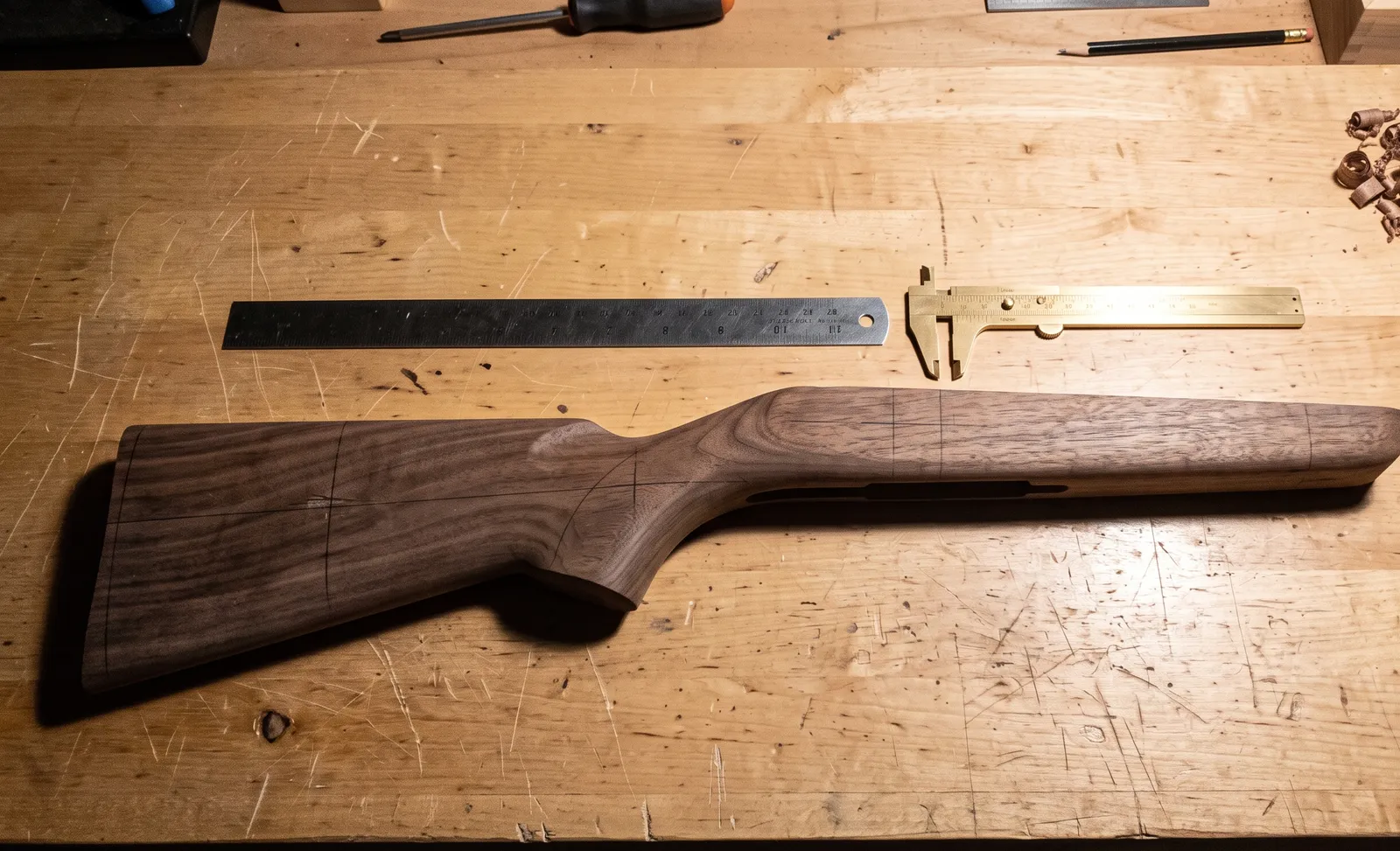
These four dimensions are the shared language between shooter and stockmaker: they are how a custom gun stock is ordered, cut and checked. On real stocking work they are everywhere: the swan-neck stock of my graduation Winchester M1885 was cut to them. And if you read French gun descriptions or auction listings, my French-English glossary of gun terms covers the whole vocabulary, from bascule to longuesse. And what comes after the dimensions is the business of the stock finish reference.
Sources
Definitions, ranges and methods cross-checked against the references below, consulted on 12 October 2026. Schools differ: where they diverge, the wider range is given and each table row names its source.
- Stock dimensions, SAAMI glossary (definitions of length of pull, drop, cast and pitch).
- Ask the instructor: basic fit, NSSA-NSCA, 2018 (straight-line measurement from the trigger; thumb one inch to an inch and a half from the nose).
- Gun fitting, Don Currie, 2014, updated 2022 (pitch: plate square to the rib and 4 degrees from the factory; cast set by the face).
- Gun fit explained, Pete Blakeley (two to three finger widths; double triggers measured from the front trigger; limits of the elbow and mirror methods).
- Length of pull, Wikipedia (definition, factory value, butt in the crook of the elbow, about two finger widths, clothing).
- Gunstocks: what do all those terms mean?, NRA Family, 2023 (13 ½ to 14 ½ in on factory guns).
- La crosse, Chasse Passion, 2011 (common French dimensions, effects of drop and cast).
- La conformité du fusil (PDF), French shooting school, undated (drop and cast tables by morphology; forearm-minus-20 mm rule).
- How to fit a gun stock, Browning (definition; 1 ⅝ and 2 ½ in drops given for most shooters).
- The fine art of the gun fit, part 1, Westley Richards (too short and too long are both faults).
- Gun fitting, Keith Coyle, and Gun fitting appointments, James Purdey & Sons (try-gun, pattern plate, watching the mount).