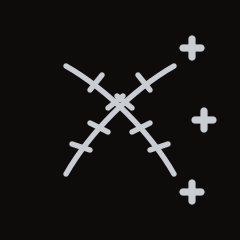
Crossed palms with “St ÉTIENNE”
c. 1897 to 2011
Optional black powder proof of finished, assembled barrels. The motif struck once, twice or three times marks ordinary, double or triple proof.
Tools · 04
Proof marks are an old gun's civil record: where it was proved, with which powder, under which regime. This reference covers the two proof houses you will meet most often on continental shotguns: Saint-Étienne and Liège. Every entry shows its period, its meaning, its sources, and above all its confidence level: what is cross-checked says so, and what is a hypothesis says so too.
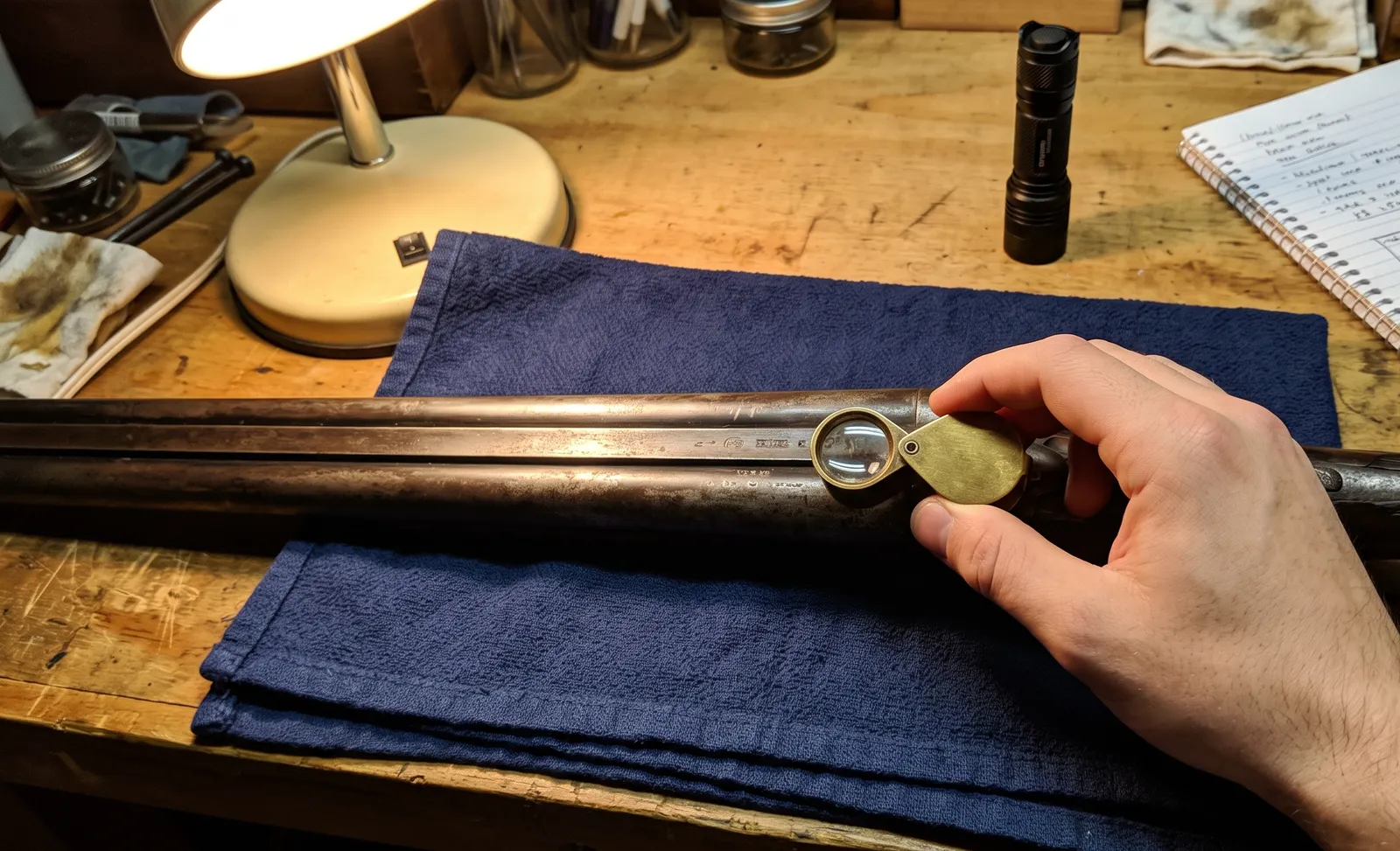
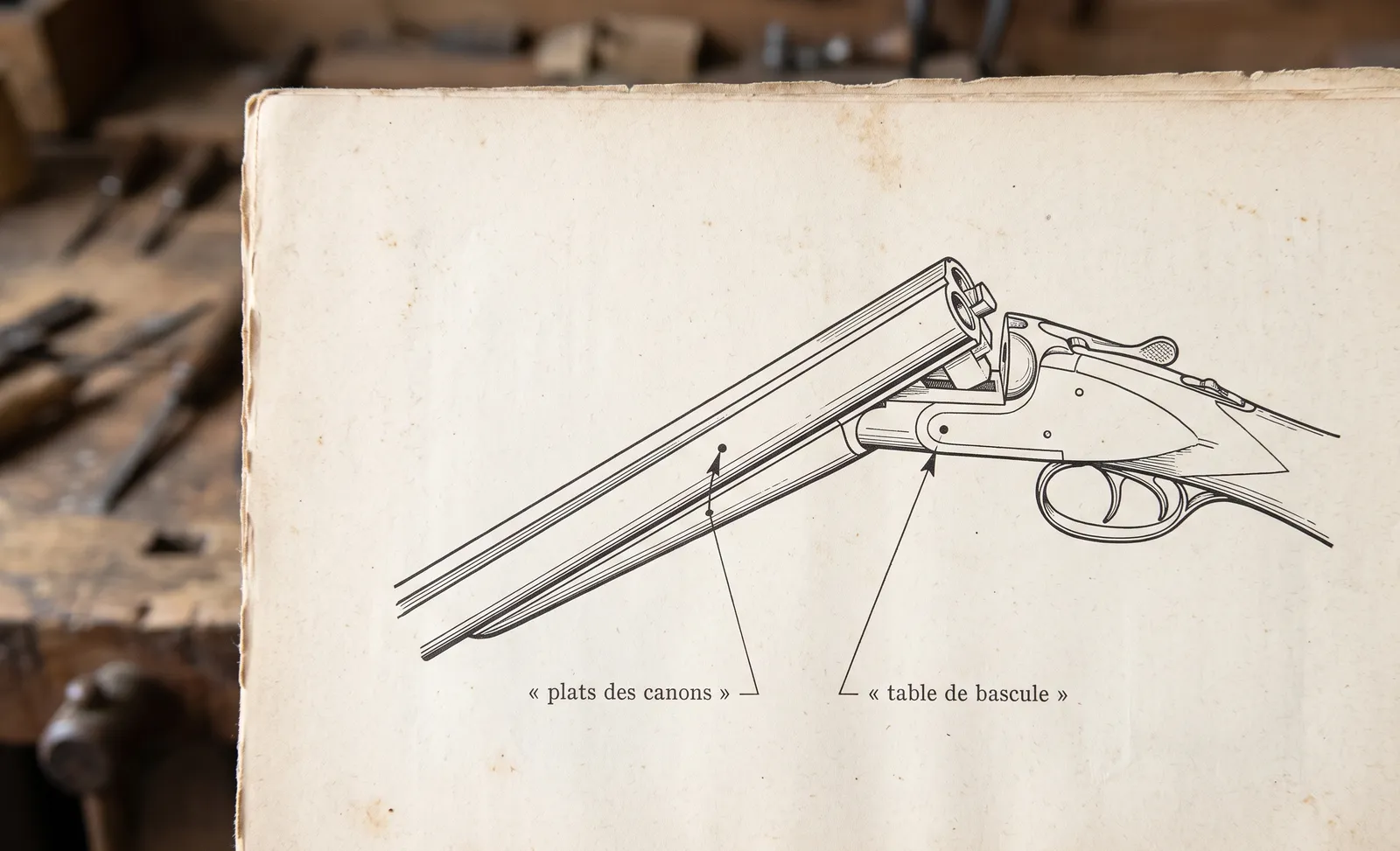
Proof marks are read on the barrel flats under the chambers and on the action flats. At Saint-Étienne, PT under a crown marks the ordinary smokeless proof (from 1900); at Liège, a small letter struck near the marks gives the year of proof from 1922 onwards.
Before you start
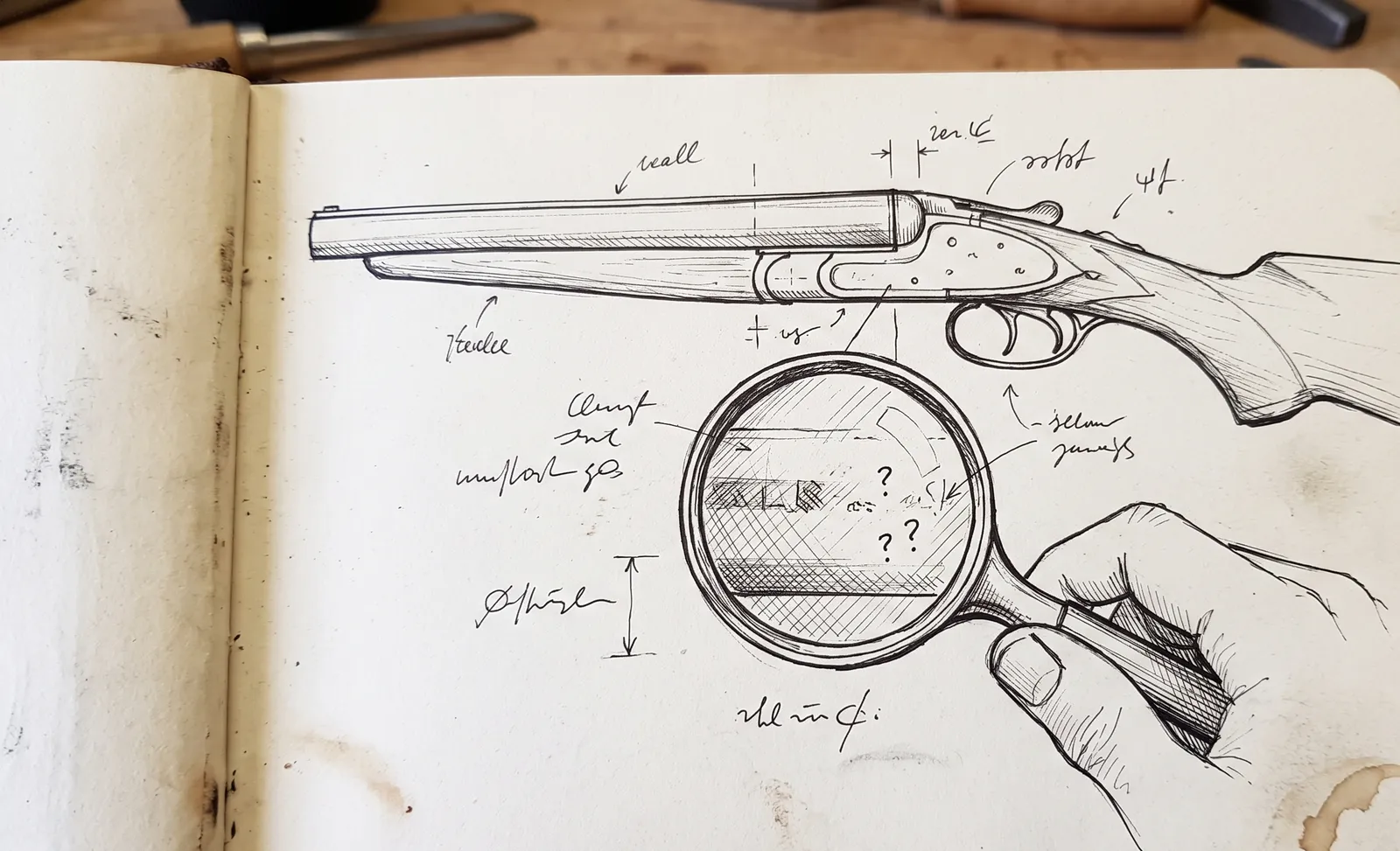
Gun unloaded and taken down (fore-end, then barrels). Never polish the markings: you would destroy exactly what you are trying to read. The drawings on this page are schematic representations redrawn from official documents, not facsimiles: real strikes vary with period and wear.
01 · Saint-Étienne
A truth this page owns, against many overconfident answers out there: France, almost alone in Europe, never used a date code on its civilian guns. A Saint-Étienne mark gives a proof regime, hence a range, never a year. It is the combination of clues (powders, dimensional markings, model, catalogues) that narrows a date down.
c. 1897 to 2011
Optional black powder proof of finished, assembled barrels. The motif struck once, twice or three times marks ordinary, double or triple proof.

1897 to 2011
Finished shotguns: ordinary black powder proof (F powder).

1897 to at least 1962
Finished shotguns: superior black powder proof. Despite what is sometimes written, this mark does not designate smoothbore barrels.

1896-97 to the 1910s-1920s (end debated: 1914, 1923 or 1926 depending on the source)
Finished guns: first-generation smokeless proof with S or J powder. Its presence dates the gun to before the mid-1920s.
Start date well established; end of use disputed between sources.

1898 (decree of 14 May 1898) to the 1910s-1920s
Finished guns: smokeless proof with M powder. Like PS, it marks a gun from before the mid-1920s.

1900 to 2011
Finished guns: ordinary smokeless proof (T powder). The archetypal French proof mark of the 20th century.

c. 1923-1926 to 2011
Finished guns: superior (reinforced) smokeless proof. The mark sought on guns proved to the higher standard.

By 1929, to 2011
Supplementary mark for guns proved in deliverable condition: the complete gun was submitted, not just its barrels.

1897 to 2011, with a change of role
First the provisional proof of barrel blanks (1929 state), later the handgun proof in the late system (CIP 2001 state). The switch date remains to be established.

By 1929, to 2011
Proof of rifled long arms. The crowned ARR variant marks their reproof.

20th century, to 2011
The gun failed proof: rejected. Not to be confused with the crowned R reproof marks.

Before 2001, still in force
Reinforced “steel shot” proof of smoothbore barrels: required for high-performance steel shot.

Since 2011
The current system: a hexagonal CIP shield containing N (ordinary proof), S (superior) or PN (black powder), alongside the proof house identification mark.
02 · Liège
Belgium is the opposite case of France: a gun proved at Liège can usually be dated to the year. The marks come as a stack, and each one narrows the range. The crowned ELG oval is the definitive acceptance mark, and in that form it is the clearest “after 1893” signal on a Belgian gun. The Perron, the Liège monument, has been struck for the inspection of the locking system since 1853, so its presence alone puts the gun after that year. The lion over PV is the smokeless powder proof: a Belgian shotgun without it, and without nitro proof, is very probably 19th century. And from 1922 a small date letter gives the year of proof, which the dater further down reads for you.

1811 to 1846; later reserved for muzzle-loaders
The Liège definitive black powder proof, in its early form without star or crown.
The 1846 boundary (star added) rests mainly on littlegun.be.

1846 to 1893
Definitive black powder acceptance. A Belgian gun with this UNcrowned oval was proved before July 1893.

From 11 July 1893 (in this form until 1968)
Definitive acceptance and proof. The crown above the oval is THE “after 1893” marker on Belgian guns.

1853 to the present (already the sole mark from 1672 to 1810)
Liège's emblematic monument, struck since 1853 for the inspection of the locking system. Its presence dates the gun after 1853.

1898 to 1968 in this form
Smokeless powder proof. A Belgian gun without this lion and without nitro proof is very probably 19th century.

1894 to 1968
Rifled barrel. Beware the homonym: an UNcrowned R (1846-1889) marked a barrel rejected at proof.

1852 to the present (smoothbores only since 1924)
Provisional proof of the barrel, before the breech is fitted.

1877 to the present in this form (suspended 1968-1973)
Personal countermark of the proof house controller. The letter I was never assigned. Published name rosters diverge: we do not publish names.

1898 to 30 June 1924
The nominal gauge (e.g. 12 C) struck in a lozenge. A precious dating marker: its presence places the proof before mid-1924.
Since 1924
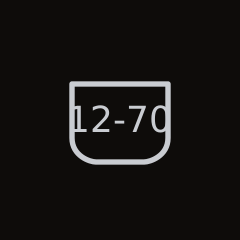
Gauge and chamber length in millimetres, in a cartouche. Replaces the lozenge: its presence places the proof after 1924.
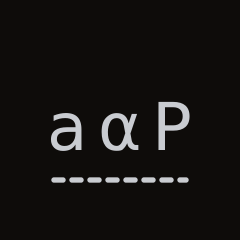
1922 to 1999 (published tables; after 1999, not documented online)
A small letter struck near the proof marks gives the YEAR OF PROOF (not necessarily manufacture). Four cycles: lowercase 1922-1947, Greek letters 1948-1961, lowercase again 1962-1987, uppercase in non-alphabetical order 1988-1999. Use the dater below.
03 · The Liège dater
From 1922, the Liège proof house struck a date letter next to its marks. Enter it below: the tool returns the year of proof. Lowercase letters served twice (1922-1947, then 1962-1987): when it is ambiguous, the tool asks for a clue and, failing that, gives both candidates. The year is the year of PROOF, not necessarily of manufacture: your grandfather's Belgian shotgun may be older than its reproof.
Cycle reminder: lowercase 1922-1947 (a=1922), Greek letters 1948-1961, lowercase 1962-1987 (a=1962), uppercase 1988-1999 in non-alphabetical order (P=1988 ... W=1999). After 1999: no table published online. Sources at the bottom of the page.
04 · Cross-checking
| What you see | What it implies |
|---|---|
| Gauge in a lozenge (Liège) | proved between 1898 and mid-1924 |
| 12-70 or 16-65 notation (Liège) | proved after 1924 |
| ELG oval without a crown | before July 1893 |
| Lion over PV present | after 1898 |
| Crowned ELG with no date letter | 1893-1922 window |
| Crowned PS or PM (Saint-Étienne) | before the mid-1920s |
| Crowned PT alone (Saint-Étienne) | after 1900 |
To go further: the bilingual terminology of these parts (barrel flats, action flats), and what modern proof looks like in practice on my graduation Winchester M1885, proved at the Saint-Étienne National Proof House at 2,750 bar.
Sources and method
Compiled in July 2026 by cross-checking official documents and specialist references; every entry carries its own sources and confidence level. Current scope: Saint-Étienne (late 19th century to the CIP system) and Liège. Châtellerault and the 1782-1856 Saint-Étienne marks (J.L. Gillier's dating hypotheses) will come in a later edition. Spotted an error, or missing a mark? Write to me.